
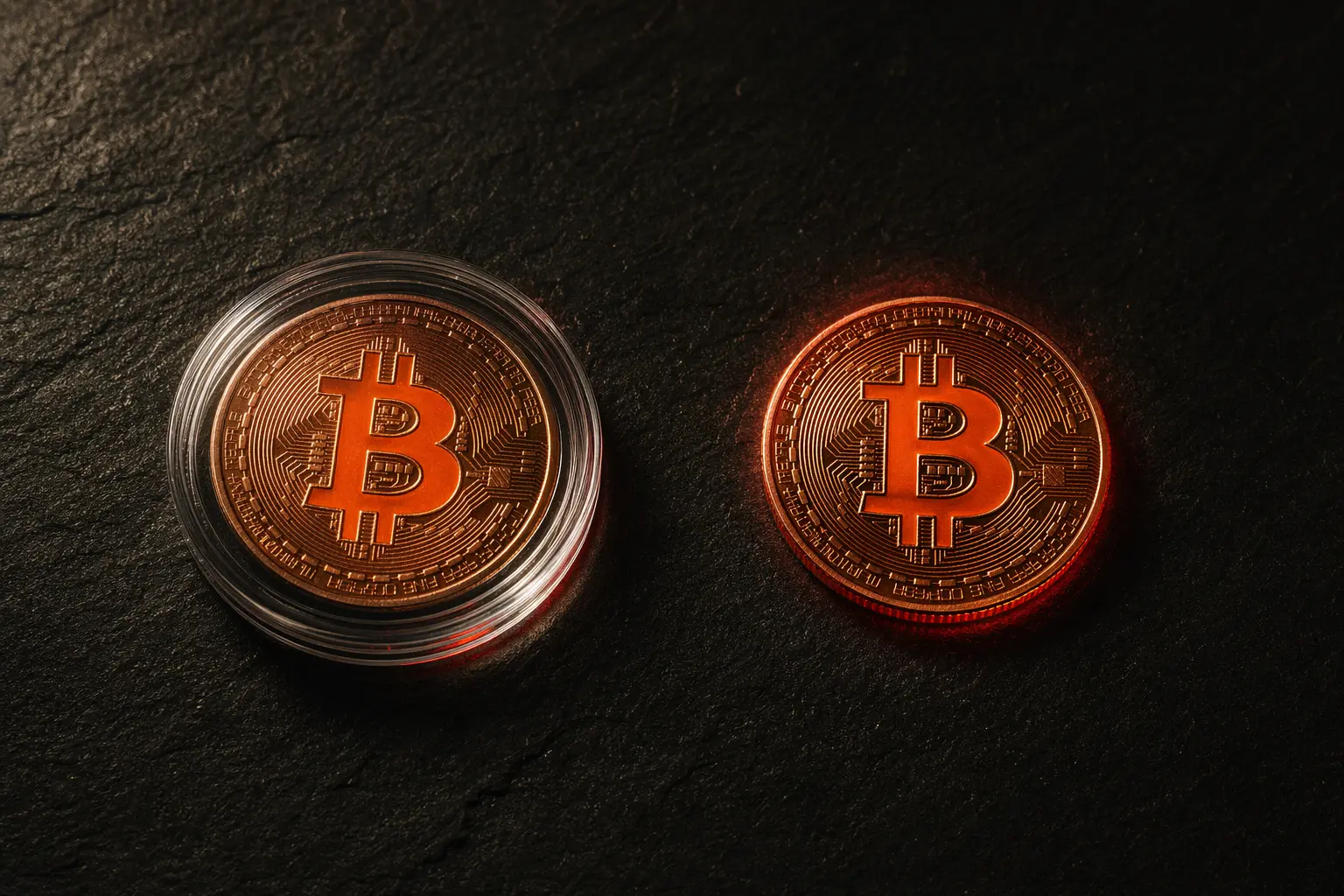
I have held Bitcoin since before spot ETFs existed. When BlackRock’s IBIT launched in January 2024 and hit $65 billion in AUM faster than any ETF in history, I had to ask myself an honest question: should I have just bought the ETF?
After doing the math on expense ratios, tax treatment, IRA eligibility, and yield potential, my answer is: it depends. If income matters, For more on using crypto in retirement accounts, see our bitcoin roth ira guide.bitcoin income ETFs like YBIT and MSTY add a layer worth understanding before you decide on where you are in your financial life. For most people, the right answer involves both – ETF for retirement accounts, spot for long-term self-custody. But the tradeoffs are not what most articles make them out to be.
TLDR
- Expense ratio math is brutal long-term: 0.25%/year costs ~$95K on a $100K investment over 20 years at 15% CAGR. GBTC’s 1.5% costs $408K.
- ETF is the only practical way to hold Bitcoin in a Roth IRA or 401k – this advantage alone changes the math for retirement investors.
- Spot Bitcoin wins on cost, self-custody, and yield potential (4-8% APY). ETF wins on tax simplicity, IRA eligibility, and zero custody hassle for non-technical holders.
The Core Difference Nobody Explains Well – Bitcoin ETF vs Spot Bitcoin
When people debate bitcoin etf vs spot bitcoin, they usually get stuck on the “not your keys” argument or the SEC approval narrative. That is noise. The actual decision breaks down into four things:
- Who controls the Bitcoin – ETF means Coinbase Custody holds it on your behalf. Spot means you hold it yourself (or trust an exchange).
- What it costs annually – ETFs charge 0.20% to 1.50% per year. Spot Bitcoin in self-custody costs almost nothing after a one-time hardware wallet purchase.
- How taxes work – ETF taxes are simple. Spot Bitcoin taxes are complex.
- Whether you need IRA access – Only ETFs work in mainstream retirement accounts.
Everything else – liquidity, regulatory risk, volatility – is roughly equal. Bitcoin is Bitcoin. The underlying asset is identical. You are paying for structure, custody, and convenience.
I want to be precise about what you are actually buying with an ETF: a wrapper. The ETF holds actual Bitcoin (spot-backed ETFs, not futures), so you get pure price exposure. But you do not own the coins. Coinbase Custody holds them for BlackRock (IBIT), Fidelity (FBTC), ARK/21Shares (ARKB), and Bitwise (BITB). If Coinbase Custody has a problem, your ETF has a problem.
Worth noting: if you use Coinbase to buy spot Bitcoin and leave it on the exchange, you are trusting Coinbase anyway – just without the regulatory oversight that comes with an ETF. Self-custody with a hardware wallet is the only way to truly eliminate counterparty risk on the spot side.
Bitcoin ETF Advantages
The case for ETFs is legitimate and I do not want to dismiss it. Let me be honest about where they win.
Tax simplicity is real. When you hold IBIT in your Fidelity or Schwab account, you get a 1099-B at tax time. Your broker handles cost basis tracking. You have one taxable event: when you sell the ETF. No tracking 47 on-chain transactions from three years ago. No figuring out whether your crypto-to-crypto swap in 2023 created a capital gain. For people who already find crypto taxes overwhelming, this matters.
IRA and 401k eligibility is the biggest advantage. Bitcoin ETFs trade on Nasdaq and NYSE. Any brokerage IRA can hold them. That means you can put IBIT in a Roth IRA and let it compound tax-free for 30 years. A $50,000 Roth IRA allocation in IBIT growing at 15% CAGR over 25 years becomes $1.6 million – and you pay zero tax on the gains. You cannot do this with spot Bitcoin through any mainstream brokerage. A self-directed IRA (SDIRA) can hold spot Bitcoin but costs $300-500/year in custodian fees and is operationally complex.
Mainstream brokerage access means no new accounts, no exchange KYC, no seed phrase management. If you already have a Fidelity or Schwab account, you can buy IBIT in two minutes.
Wash sale rule applicability is a nuanced advantage. Bitcoin spot does not currently have wash sale rules. But pending legislation may change this. ETFs do have wash sale rules – which limits tax-loss harvesting flexibility but means your positions are treated with the predictability of any stock.
Buy Bitcoin on Coinbase – Trusted by BlackRock
Low fees, regulated, trusted by 100M+ users.
Why Spot Bitcoin Still Wins for Serious Holders
If you are a long-term Bitcoin holder who believes in the asset, spot wins on almost every dimension except IRA access and tax simplicity.
The cost advantage compounds massively. A 0.25% annual fee sounds trivial and costs you six figures over a 20-year hold. Hardware wallets cost $79-149 one time. That is your entire custody cost for life.
True ownership means no counterparty. I have read enough about what happened to Genesis, Celsius, BlockFi, and FTX to take custody seriously. None of those affected people thought they were taking on counterparty risk either. ETFs are regulated and have a better structure than those platforms, but the underlying Bitcoin is still held by a third party. If Coinbase Custody had a catastrophic failure, ETF holders would have a claim – but claims during insolvency proceedings are not the same as owning the asset.
Yield generation is only possible with spot. If you hold actual Bitcoin, you can put it to work. Platforms like Coinbase Advanced Trade, Ledn, and various DeFi protocols offer 4-8% APY on Bitcoin. None of this is possible with an ETF – you own a share in a trust, not actual Bitcoin.
24/7 trading without market hours. Spot Bitcoin trades around the clock. ETFs only trade during NYSE/Nasdaq hours. During weekend volatility – which Bitcoin gets regularly – ETF holders cannot react until Monday morning.
For my long-term perspective on Bitcoin allocation, see the InvestAnswers BTC allocation model I use in practice.
The Expense Ratio Math Over 20 Years
This is the section most articles skip because the numbers are uncomfortable for ETF bulls. I will not skip it.
Scenario: $100,000 invested, 15% CAGR over 20 years.
| ETF / Option | Annual Fee | 20-Year Value | Fee Drag |
|---|---|---|---|
| Spot Bitcoin (self-custody) | ~$0/yr* | $1,636,654 | – |
| BITB (Bitwise) | 0.20% | $1,570,013 | $66,641 |
| IBIT (BlackRock) | 0.25% | $1,541,507 | $95,147 |
| FBTC (Fidelity) | 0.25% | $1,541,507 | $95,147 |
| GBTC (Grayscale) | 1.50% | $1,228,043 | $408,611 |
*One-time hardware wallet cost of $149 excluded.
The IBIT/FBTC drag of $95K on a $100K investment is not small. That is essentially your entire original investment lost to fees over 20 years. At $500K invested, it becomes $475K in fee drag at IBIT rates – and $2 million in fee drag at GBTC rates.
The practical implication: if you are going to hold a Bitcoin ETF, never hold GBTC. The legacy product is a wealth transfer from you to Grayscale. IBIT and FBTC are identical in exposure at 6x lower cost. There is no reason to hold GBTC unless you are locked in by tax circumstances.
For a broader look at how ETF supply accumulation is affecting Bitcoin’s price dynamics, see this analysis of Bitcoin ETFs holding 6.77% of BTC supply.
Tax Complexity: ETF vs Spot
ETF taxation: – One taxable event: selling ETF shares – Broker issues 1099-B with automatic cost basis tracking – Long-term capital gains rate (under 20%) applies if held over 1 year – Wash sale rule applies: 30-day waiting period after a loss sale before buying back – No tax events from ETF rebalancing (handled internally)
Spot Bitcoin taxation: – Every disposal is a taxable event: selling for USD, trading BTC for ETH, buying anything with Bitcoin – Self-reported: you must track every transaction or use software like Koinly, CoinTracker, or TaxBit – No wash sale rule currently (IRS treats crypto as property) – advantage for tax-loss harvesting – Cost basis method choice (FIFO, LIFO, HIFO) can significantly affect tax liability – Staking/yield payments are taxed as ordinary income when received
If your Bitcoin strategy is “buy and hold for 20 years,” spot Bitcoin’s tax complexity drops to nearly zero: buy, hold, sell once. You still need to track your purchase dates and prices, but it is not complicated.
IRA/Retirement Accounts: ETF Only
This is the clearest-cut advantage for ETFs and the one I think gets underweighted.
The U.S. tax code allows you to hold ETFs in IRA and 401k accounts. It does not allow you to hold actual cryptocurrency in a standard brokerage IRA. The self-directed IRA loophole exists but requires specialized custodians, annual fees of $300-500+, and operational complexity most investors are not equipped to handle.
Bitcoin ETFs solve this entirely. You can put IBIT in a Roth IRA at Fidelity today in under five minutes. The tax implications:
- Roth IRA: After-tax contributions. All gains are tax-free at withdrawal. $100K in IBIT growing to $1.6M over 25 years – you owe zero tax on $1.5M in gains.
- Traditional IRA: Pre-tax contributions. Growth is tax-deferred. Pay ordinary income tax at withdrawal.
- 401k (if plan allows): Some providers now offer Bitcoin ETF as an option.
If you have meaningful retirement account contribution room and believe in Bitcoin long-term, the IRA access argument for ETFs may outweigh the expense ratio drag. The Roth IRA scenario in particular is compelling.
For context on long-term Bitcoin wealth projections, see Bitcoin wealth projections for 2032.
Comparison Table: Bitcoin ETF vs Spot Bitcoin
| Factor | Bitcoin ETF (IBIT/FBTC) | Spot Bitcoin (Self-Custody) | Winner |
|---|---|---|---|
| Annual Cost | 0.20-0.25%/yr ($200-250 per $100K) | ~$0/yr after $79-149 hardware wallet | Spot Bitcoin |
| Custody Risk | Coinbase Custody holds BTC for fund | You hold keys; zero counterparty | Spot Bitcoin |
| Tax Complexity | Simple – broker 1099-B, one event | Complex – every tx is taxable event | ETF |
| IRA/401k Eligible | Yes – any brokerage IRA | SDIRA only ($300-500/yr custodian) | ETF |
| Yield Potential | 0% – no yield generation possible | 4-8% APY via lending/DeFi | Spot Bitcoin |
| Counterparty Risk | Yes (Coinbase Custody + fund manager) | Zero with hardware wallet | Spot Bitcoin |
| Regulatory Risk | Can be suspended/delisted by SEC | Cannot be seized if self-custodied | Spot Bitcoin |
| Trading Hours | Market hours only (9:30AM-4PM ET) | 24/7 trading | Spot Bitcoin |
| Ease of Access | Any brokerage, no crypto knowledge needed | Requires exchange + wallet setup | ETF |
My Take: What I Actually Do
I hold both. That is my honest answer after thinking about this for years.
My retirement accounts hold Bitcoin ETFs. I have IBIT in a Roth IRA because the tax-free compounding math is too good to ignore. Yes, I am paying 0.25% per year. In a Roth IRA, that fee drag is the cost of never paying capital gains tax. On a multi-decade hold, I think that trade is worth it. A third option worth knowing: holding spot Bitcoin inside a crypto IRA for tax-free compounding in a Roth account.
For my non-retirement allocation, I hold spot Bitcoin in self-custody. Hardware wallet, seed phrase stored securely. I chose this path because I want actual Bitcoin – not a promise backed by a custodian, no matter how reputable. The cost math also works: after buying a Ledger once, I pay nothing annually. That gap in costs between the ETF and self-custody route grows every year.
What I would tell a new investor: if managing seed phrases feels overwhelming, start with a Bitcoin ETF. Learn the asset. Get comfortable. Then, when ready, consider moving a portion into self-custody. You do not have to choose one path forever.
What I would tell existing spot holders: if you have meaningful retirement account contribution room you are not maximizing, seriously consider opening an IRA and putting Bitcoin ETF allocation there. The tax-free Roth compounding is real money.
For more on getting started with Coinbase’s trading interface, see the Coinbase Advanced Trade guide for 2026.
If you are thinking about self-custody, see the best hardware wallets of 2026 ranked by security.
Ready to Buy Bitcoin? Start on Coinbase
No minimums, regulated, trusted by institutions.
Frequently Asked Questions
Is a Bitcoin ETF safer than holding spot Bitcoin?
It depends on how you define “safer.” A Bitcoin ETF removes the risk of losing your seed phrase and gets you regulated fund oversight. But it introduces counterparty risk – Coinbase Custody holds the actual Bitcoin for most major ETFs. Spot Bitcoin held in self-custody with a hardware wallet has zero counterparty risk but requires technical competence to manage securely. For non-technical investors, the ETF is probably safer in practice. For experienced Bitcoin holders, self-custody eliminates the third-party risk entirely.
Can you hold a Bitcoin ETF in a Roth IRA?
Yes. IBIT, FBTC, ARKB, and BITB all trade on major exchanges and are available in any brokerage IRA – including Roth IRAs at Fidelity, Schwab, and others. This is one of the strongest arguments for Bitcoin ETFs. Spot Bitcoin requires a self-directed IRA (SDIRA) with specialized custodians that charge $300-500/year in additional fees.
Does the 0.25% expense ratio really matter long-term?
Yes, significantly. At 0.25%/year on $100,000 growing at 15% CAGR over 20 years, you lose approximately $95,147 to fees compared to cost-free spot Bitcoin ownership. At $500K invested, that gap reaches $475K. The drag compounds – you lose not just the fee money but all the future growth that money would have generated. GBTC’s 1.5% fee is even worse: $408K drag on $100K invested over 20 years.
What happens to Bitcoin ETFs if the SEC changes crypto rules?
Bitcoin spot ETFs were approved under specific SEC guidance. A regulatory reversal is theoretically possible but would require unwinding $110B+ in institutional holdings. The more realistic risk is fund closure by the sponsor, which would return cash to investors at NAV. Your Bitcoin ETF could become cash with no notice period. Spot Bitcoin holders face no equivalent risk.
Should I hold GBTC or switch to IBIT/FBTC?
If you hold GBTC and are considering the switch, do the math on your tax situation first. Selling GBTC triggers a taxable event on any gains. If you are sitting on large gains, the tax bill from switching might exceed the fee savings for several years. If you have minimal gains or are in a tax-advantaged account, switch immediately. GBTC’s 1.5% fee versus IBIT’s 0.25% is a 6x cost difference for identical exposure.
For a deeper look at Bitcoin’s long-term price modeling, see Bitcoin Stock-to-Flow Model 2026: Useful or Just Cope?